
Caterpillar Generator Logo

Application-led selection

Caterpillar Generator Applications

The same generator rating can behave very differently across a hospital, data center, industrial process, or remote utility site. Start with the consequence of interruption and the load behavior.

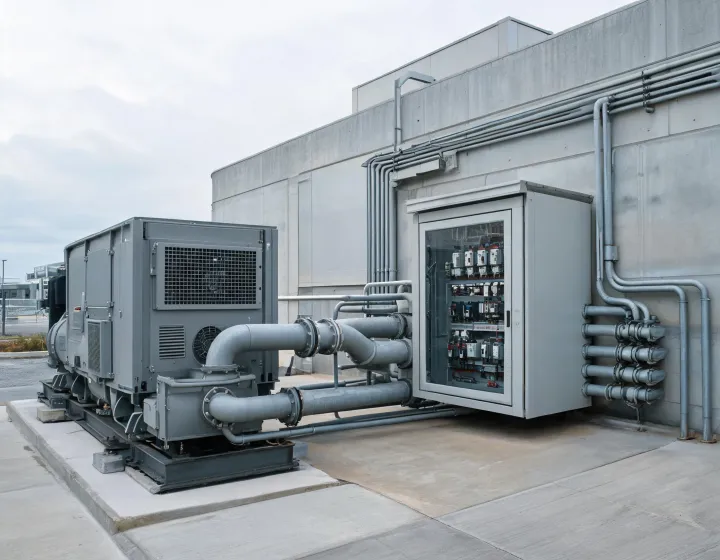
Standby generator serving a critical facility

Choose by operating consequence

Which application profile is closest?

These cards are conversation starters, not final sizing rules. Each highlights the questions that tend to change the configuration, controls, testing plan, or package boundary.

A

Data Centers & Digital Infrastructure

Generator systems must coordinate with UPS ride-through, transfer schemes, staged cooling loads, block loading, redundancy targets, and periodic testing. Selection should evaluate transient response, harmonic content, paralleling requirements, fuel autonomy, controls integration, and maintainability under an N, N+1, or distributed architecture. Confirm the accepted rating basis and site conditions before comparing nameplate output.

  • UPS and step-load interaction
  • Paralleling and network monitoring
  • Fuel resilience and test strategy
Discuss critical power
B

Healthcare & Institutional Facilities

Hospitals and care environments depend on a defined restoration sequence for life-safety, critical, and equipment branches. The system discussion includes transfer timing, selective coordination, motor starting, elevators, imaging loads, acoustic limits, emissions rules, maintenance access, and routine exercise. Local codes and the engineer of record govern the final design; our role is to make the equipment request complete enough for that review.

  • Essential electrical system priorities
  • Transfer and protection coordination
  • Testing, access, and acoustic limits
Review facility inputs
C

Industrial Plants & Process Loads

Industrial sets may encounter large across-the-line motors, variable frequency drives, welders, compressors, pumps, nonlinear control loads, heat, dust, and long operating periods. A practical review separates running load from starting events, identifies allowable voltage and frequency dip, and considers whether sequential loading can reduce required capacity. Enclosure, filtration, cooling, fuel handling, remote monitoring, and service access should be treated as system requirements rather than late accessories.

  • Motor starting and load sequencing
  • Ambient derating and duty cycle
  • Controls, enclosure, and serviceability
Map process loads
D

Commercial Buildings & Construction

Commercial properties combine life-safety loads with pumps, elevators, refrigeration, communications, and selected tenant services. Construction and rental applications add mobility, temporary distribution, grounding, cable protection, noise, fueling, and rapidly changing loads. Clarifying whether the need is fixed standby, temporary prime, or short-duration rental prevents a familiar model name from being applied to the wrong duty.

  • Fixed versus temporary duty
  • Load priority and transfer arrangement
  • Site logistics and neighborhood limits
Start application screening

Bring the single-line diagram or load list

We will help organize the missing generator inputs before the quote stage.

Review an Application