Ratings before labels
Rated output changes with duty classification and site conditions. We ask for the operating basis before presenting a number as suitable.

Focused generator sourcing
We organize generator enquiries around verifiable electrical and operating requirements. The goal is a shorter path from an incomplete request to a configuration that can be reviewed by the responsible engineer, contractor, and buyer.
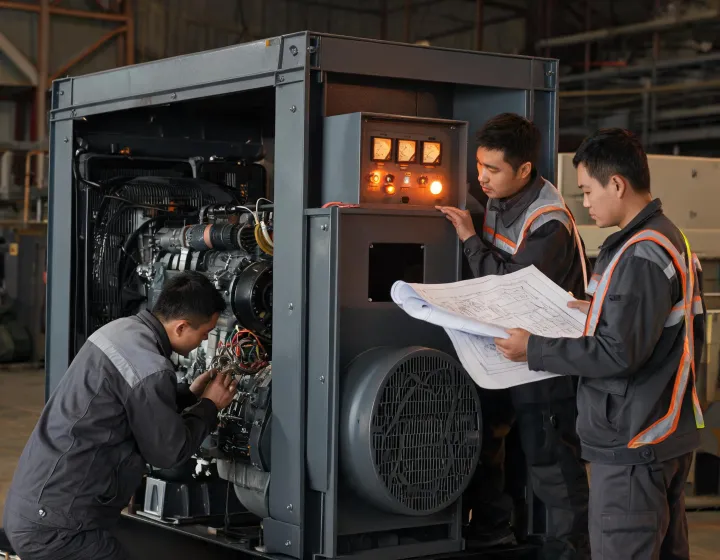
Rated output changes with duty classification and site conditions. We ask for the operating basis before presenting a number as suitable.
UL, IEC, CE, emissions, and local installation requirements are confirmed for the specific package and destination rather than implied across every set.
Enclosure, controls, transfer equipment, freight, commissioning, and field labor are identified as included, optional, or excluded.
A disciplined request path
Our process is intentionally compact, but not casual. Each checkpoint exists because skipping it can move cost or risk downstream.
Standby, prime, continuous, and temporary applications impose different expectations for hours, loading, redundancy, and maintenance. We record the intended operating model and any governing project specification.
Running kW, kVA, power factor, largest motor, starting method, nonlinear loads, permissible voltage dip, and future growth are gathered for engineering review. A generator is not selected from connected load alone.
Altitude, temperature, ventilation, sound, weather exposure, fuel autonomy, access, lifting, conduit routes, and exhaust constraints shape the package and site work.
The final request states destination, schedule, documentation needs, installation responsibility, commissioning expectation, and the accessories included in the comparison.
Send destination, timing, and scope for pricing coordination.